If you’ve ever traded options on the NSE or BSE, you know how fast things move. One wrong click, one extra zero, or a sleepy moment — and suddenly your screen lights up with a massive, unexpected loss. These are the dreaded “fat finger” errors, and they’ve cost Indian traders crores over the years.
Now, market regulator SEBI is stepping in with what could be a game-changer. According to fresh reports, the regulator is actively considering dynamic narrow price bands for options contracts to prevent these costly mistakes from executing at unrealistic levels.
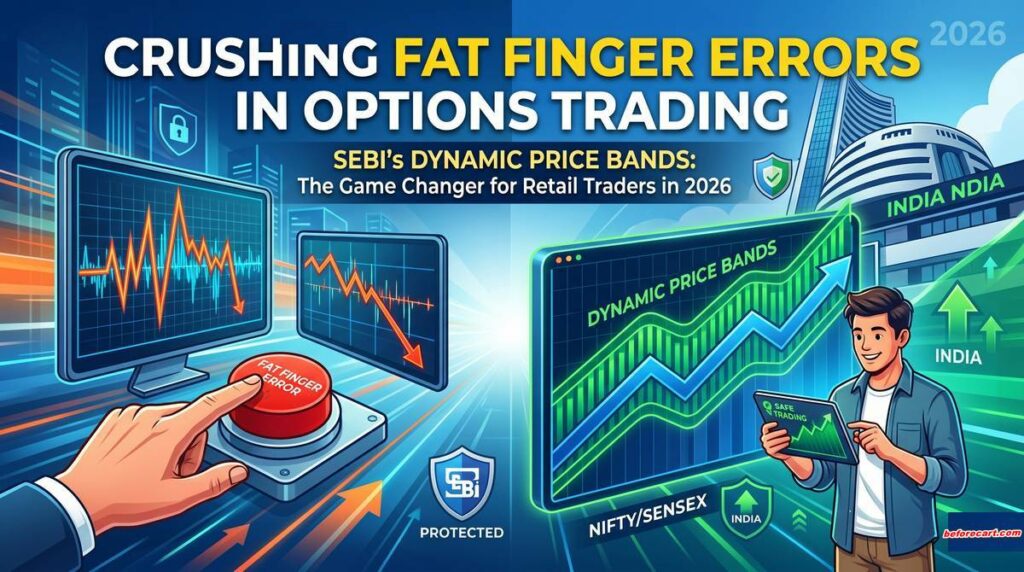
This isn’t just another rule tweak. It could finally make India’s booming options market safer for the millions of retail traders who jumped in during the post-COVID trading frenzy.
What Exactly Are ‘Fat Finger’ Errors — And Why Do They Hurt So Much?
Table of Contents
“Fat finger” is trader slang for simple human mistakes — typing the wrong price, wrong quantity, or hitting “market order” instead of “limit order” by accident.
In options trading, where premiums can swing wildly in seconds, these errors get amplified:
- A trader in 2023 accidentally bought Sensex call options at absurdly high premiums, triggering a Rs 78 lakh loss in minutes.
- Sudden artificial spikes or crashes in option prices confuse algorithms and genuine participants.
- The market briefly looks broken, then snaps back — but someone has already paid the price.
India’s derivatives segment has exploded in volume. Retail participation is at record highs. With that growth comes higher chances of manual errors, especially among new traders using mobile apps late at night.
SEBI has been watching closely. Past attempts like volatility control bands (introduced by NSE in 2021-22 and later advised for other exchanges) helped, but they weren’t enough for the hyper-active options segment.
Here’s What SEBI Is Planning: Dynamic Narrow Price Bands Explained
Instead of the current static (fixed) price bands that are often too wide, SEBI may direct exchanges to introduce dynamic narrow price bands for options.
How it will work (based on sources close to the development):
- Bands will adjust in real time depending on market conditions, recent trades, and volatility.
- Erroneous orders far outside reasonable price ranges will get blocked automatically before execution.
- Pre-trade checks will become stricter, with better order validation.
- Repeated offenders (trading members) could face tighter monitoring or penalties.
Think of it like a smart speed breaker on a highway. The limit isn’t fixed forever — it tightens when traffic gets risky and loosens when everything is smooth.
This builds on SEBI’s earlier 2024 enhancements to dynamic price bands in equity and futures segments, where conditions for “flexing” bands were made stricter (requiring more trades from unique clients) to avoid fat-finger triggers.
Why This Move Comes at the Perfect Time
Options trading in India has become the favourite playground for retail investors. Daily volumes often cross ₹1 lakh crore. But with great volume comes great responsibility — and risk.
SEBI’s latest thinking focuses on three goals:
- Protect retail traders from accidental wipeouts.
- Maintain market integrity so genuine price discovery isn’t distorted.
- Balance innovation — keep the market fast and liquid without becoming chaotic.
Exchanges like NSE and BSE will now be asked to submit detailed proposals. Once finalised, these guidelines could roll out in the coming months.
What Does This Mean for You as a Trader?
Good news for most retail traders:
- Fewer nightmare trades where one mistake costs your entire day’s profit (or more).
- More confidence while trading high-volatility instruments like BankNifty or Nifty weekly options.
- Reduced chances of “phantom” price spikes that trigger stop-losses unnecessarily.
Possible short-term impact:
- Some algo traders and high-frequency participants may need to adjust their systems.
- Slightly slower execution in very volatile moments (but safer overall).
- Better overall market stability, which benefits long-term participants.
Experienced traders already use limit orders and double-check entries. This new framework will act as an extra safety net for everyone — especially beginners who form the bulk of today’s options volume.
Will This Kill Liquidity? Experts Say No
Seasoned market watchers believe dynamic bands strike the right balance. They won’t stop legitimate volatility (which is the soul of options trading) but will filter out obvious human errors.
Remember: NSE’s earlier volatility bands didn’t kill liquidity — they actually made the market more orderly during stressful periods.
How Traders Can Prepare Right Now (Before the Rules Kick In)
- Always use limit orders instead of market orders in options.
- Double-check strike price, quantity, and premium before hitting “Buy/Sell”.
- Set realistic price alerts and avoid trading when tired or distracted.
- Keep position sizes small until you’re fully comfortable.
- Stay updated — rules like this usually come with a 30-60 day implementation window.
At Beforecart, we regularly track SEBI circulars and exchange notices so you don’t have to. Bookmark us for timely trading alerts and strategy guides.
FAQs: SEBI’s Dynamic Price Bands for Options
Q: When will these new rules actually start?
A: Still in planning stage. Exchanges need to submit proposals first. Expect updates by mid-2026.
Q: Will this affect weekly expiries or F&O ban periods?
A: No. This is specifically about preventing erroneous order execution, not changing expiry structure.
Q: Are intraday option traders the most affected?
A: Yes — they benefit the most because fat-finger mistakes happen fastest in short timeframes.
Q: Is this only for index options or stock options too?
A: Sources indicate it will cover the entire options segment.
The Bigger Picture: SEBI’s Push for Safer Markets
This latest move fits into SEBI’s larger 2025-26 agenda — cooling excessive speculation while protecting genuine investors. From stricter entry norms for new traders to enhanced surveillance, the regulator is making derivatives trading more sustainable.
For India’s young trading community, this is ultimately empowering. Safer markets mean more people can participate without fear of one silly mistake ending their journey.
What’s your take? Have you ever faced a fat-finger scare in options? Drop your experience in the comments below. We read every one.
Stay ahead of the curve with Beforecart — your one-stop destination for stock analysis, business model breakdowns, mutual fund comparisons, and real-talk trading strategies that actually work in the Indian market.
Follow us for daily market updates and never miss a SEBI or exchange circular again.
(Disclaimer: This article is for informational purposes only and not investment advice. Always consult your financial advisor befo