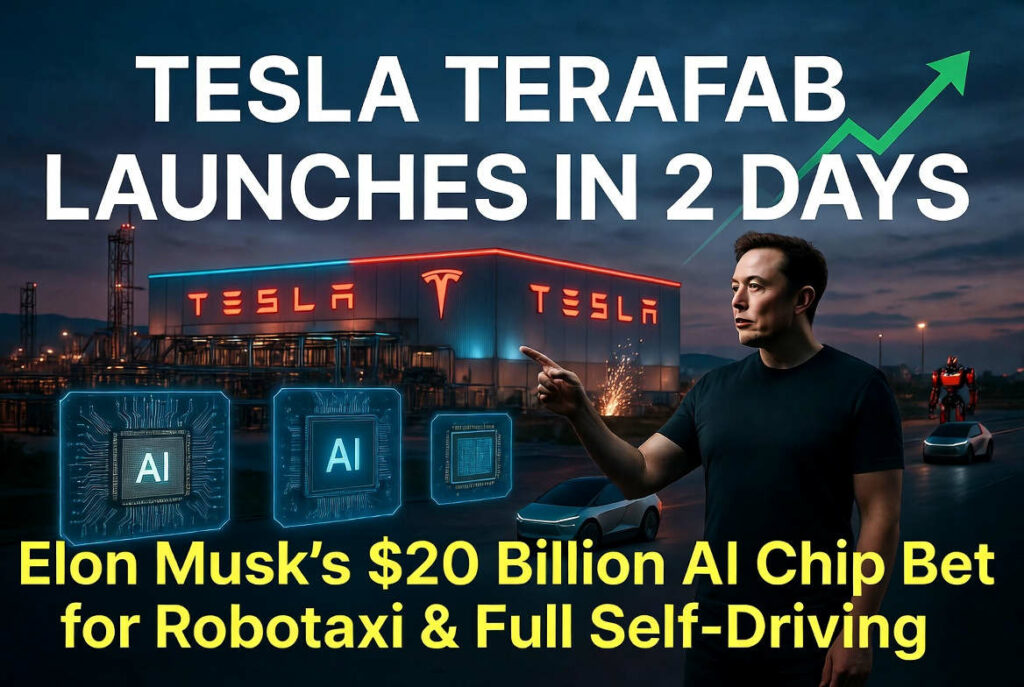
Elon Musk just dropped one of his boldest moves yet — and it officially begins this Friday, March 21, 2026. On March 14, the Tesla CEO posted on X: “Terafab Project launches in 7 days.”
No flashy video. No press event. Just a short message that sent ripples across Wall Street because Tesla is no longer waiting for TSMC or Samsung. It’s building its own massive AI chip factory — a “Terafab” that Musk calls “like Giga but way bigger.”
For US investors holding TSLA stock or betting on the AI revolution, this could be the turning point that decides whether Tesla dominates robotaxis and humanoid robots… or faces years of delays and billions in spending.
Here’s the full breakdown, the real risks, and exactly what this means for your 2026 portfolio.
What Exactly Is the Tesla Terafab?
Table of Contents
The Terafab is a fully vertically integrated semiconductor factory that will design, manufacture, and package advanced AI chips in one location.
Key details confirmed so far:
- Projected investment: Around $20 billion (according to multiple reports tracking the project).
- Purpose: Produce the massive volumes of AI chips Tesla needs for Full Self-Driving (FSD), Cybercab robotaxis, and Optimus humanoid robots.
- First focus: Next-generation AI5 chips on cutting-edge process technology.
- Location: Signs point to the North Campus expansion at Giga Texas in Austin.
Musk has been warning about this for months. In earlier earnings calls and interviews, he said even the best-case supply from external foundries won’t be enough. “We’re probably going to have to build a gigantic chip fab,” he stated. The Terafab is that plan in action.
Why Tesla Needs This Now — The Robotaxi and Optimus Explosion
Tesla’s future is no longer just about selling cars. It’s about scaling AI at an unprecedented level:
- Full Self-Driving & Robotaxi: Millions of vehicles and dedicated Cybercab fleets need enormous onboard compute power.
- Optimus Robots: Musk has repeatedly called Optimus “bigger than everything else combined.” Scaling to millions of units requires billions of specialized AI chips.
- Supply freedom: By owning the factory, Tesla removes dependence on Asian suppliers and controls its timeline.
If the Terafab succeeds, Tesla gains a huge competitive moat that competitors like Waymo still lack.
How Wall Street Is Reacting Right Now
After the March 14 announcement, TSLA saw typical profit-taking but analysts remain focused on the long game.
The project directly solves the biggest risk to Tesla’s 2026–2030 growth story. Owning the full AI stack (software + silicon) is a game-changer. However, the market wants proof: exact production timelines, first wafers, and real capex numbers.
Friday’s launch is only the starting gun — real results will unfold throughout 2026 and 2027.
Risks US Investors Must Watch Closely
No big Musk project comes without challenges. Here’s the honest reality check:
- Massive capital spending ($20 billion+ likely) will pressure cash flow in 2026–2027.
- Building a leading-edge chip fab from scratch is extremely difficult — even experienced players like Intel have faced delays.
- Timeline uncertainty: Musk gave no firm dates for the first AI5 chips or full-scale output.
- Market conditions: Any slowdown in AI investment or broader recession could hurt the narrative.
This is why some are calling it a potential “dead-cat bounce” setup — big excitement now, but execution proof needed later.
2026 Portfolio Action Plan for American Investors
If you’re in the US and invested in Tesla or the AI sector, smart money is approaching it this way:
- Long-term holders: Many are using recent dips to add, viewing Terafab as the catalyst that finally makes robotaxi economics realistic.
- Key milestones to track: First production updates, AI5 benchmarks, and any supply-chain announcements.
- Diversification tip: Pair TSLA with semiconductor equipment or memory stocks that also benefit from exploding AI demand.
- Risk control: Use stop-losses if you’re trading short-term; this story is multi-year.
Even for investors outside the US, this move strengthens Tesla’s AI leadership and could push the stock to new highs if execution hits.
Bottom Line: Dead Cat Bounce or True 2026 Winner?
The Tesla Terafab isn’t just another headline — it’s Elon Musk putting serious money and a firm deadline behind his vision of total AI control.
In two days, the project officially launches. By the end of 2026, we’ll have a much clearer picture of whether it was a stroke of genius or an overly ambitious bet.
One thing is certain: the next chapter of Tesla’s story has begun, and millions of American investors are watching closely.
What’s your take — will the Terafab deliver the robotaxi future faster than expected, or will it take longer than Musk hopes? Share your thoughts in the comments below.